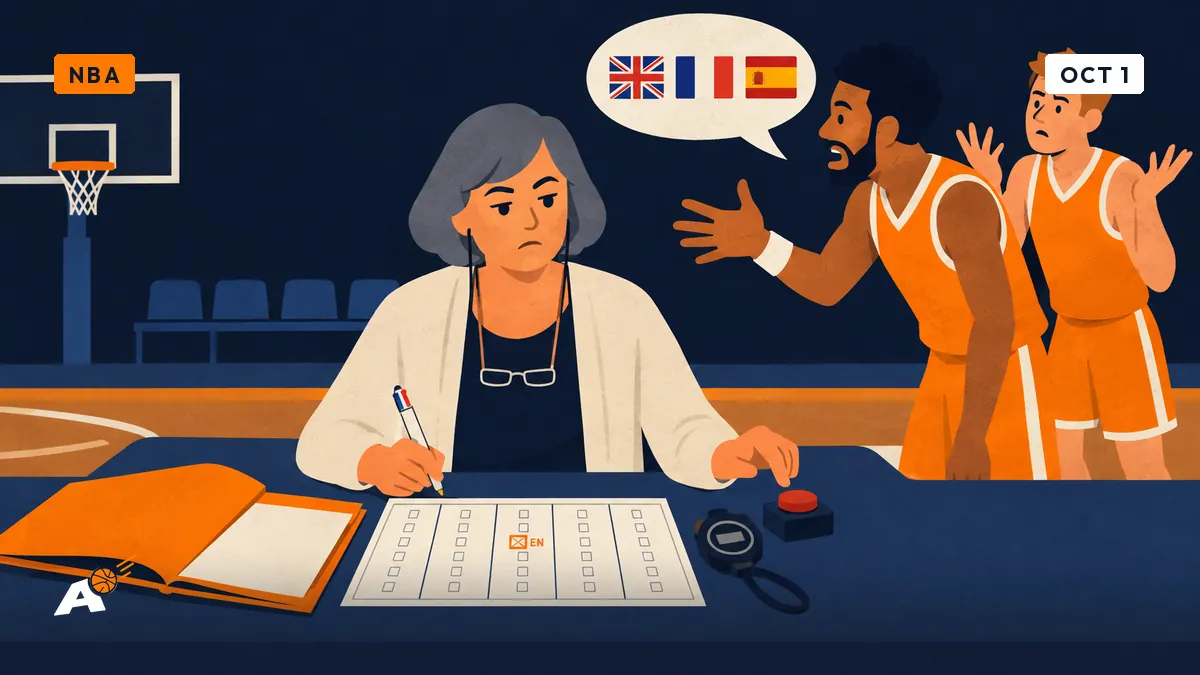
Austin Reaves plays with Luka Doncic at the Lakers. He told ESPN LA, smiling, what gives him the most trouble. Not the defence. Not the schedule. The language. “The hardest part is to understand his English on the court,” he said. Then: “He gets to talking fast, speaking in Slovenian, Serbian. He speaks four languages.”
I read that at home, the folder open on the kitchen table, because that’s where I put it away on Tuesdays. Four languages. My sheet has one. It has six columns, a box for the name, one for the number, boxes for fouls and time-outs. There’s no box for the language in which the time-out is requested. I check every Saturday, in case the federation has added one. It hasn’t.
The line I keep is the last one. “Sometimes I’m looking at him and I’m like, ‘English. Talk to me in English. I need English.’” A player asking for a language in the middle of play. In our hall, people ask for a time-out, a score correction, sometimes the time. Nobody has asked me for a language yet. If it happens, it will be during a live ball, and I don’t answer during a live ball.
Reaves and Doncic are now the pillars of a reshuffled team, after the departure of LeBron James, who spent eight seasons in Los Angeles. Two pillars, and between them three languages too many for one of the two. I observe. The clock, for its part, runs in all of them.
I announce in two languages and half the hall thinks that’s already a lot.
Noted: call in Slovenian, reply in English, ball still live. It’s on the sheet.
It’s true, we checked: BasketNews.